


ANT4CLIM
“High-resolution on-board antenna systems for radiometric monitoring of climate change impact on coastal and fluvial areas – feeder structure
(TED2021-130650B-C21)
2022-2025
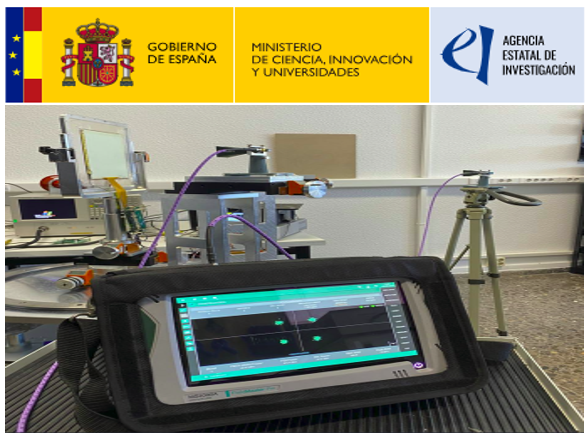
This project has developed new radiating system technologies for satellites dedicated to observing coastal and riverine areas, which are highly vulnerable to climate change.This project has developed new radiating system technologies for satellites dedicated to observing coastal and riverine areas, which are highly vulnerable to climate change.
ENHANCE-5G
“Enabling Antenna Technologies for Smart Connectivity in mm-Wave 5G and Beyond” PID2020-114172RB-C22
2021-2025
Several antenna technologies that could enable millimeter-wave communications networks to provide smart connectivity beyond 5G have been demonstrated. Spatially fed devices operating in free-space conditions have been developed, such as reflectarray antennas or intelligent reflective surfaces, both passive and electronically reconfigurable. The connectivity has been demonstrated in real-world environments for certain channel parameters using these devices.
REALSAT
“Reflectarray-based Antennas for SmallGEO and LEO Communications Satellites” PDC2021-120959-C21-2”
2021-2023
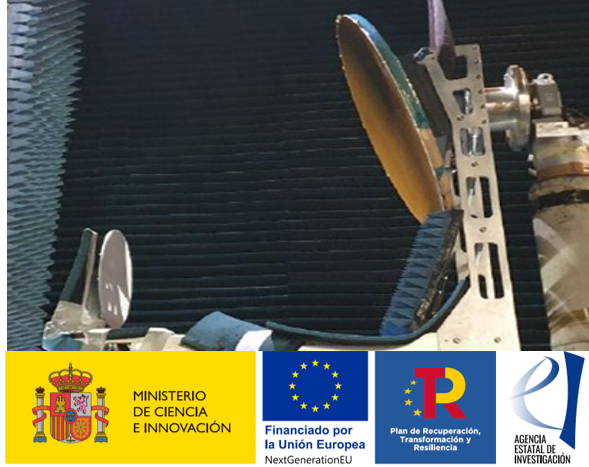
A multi-beam antenna in Ka-band has been validated by manufacturing and testing a demonstrator scaled ½ of a real satellite antenna to provide broadband internet access.
HYBRID METHODS
“New hybrid methods for optimizing high-frequency circuits and antenna arrays (TEC2017-83352-C2-1-P)”
2018-2020
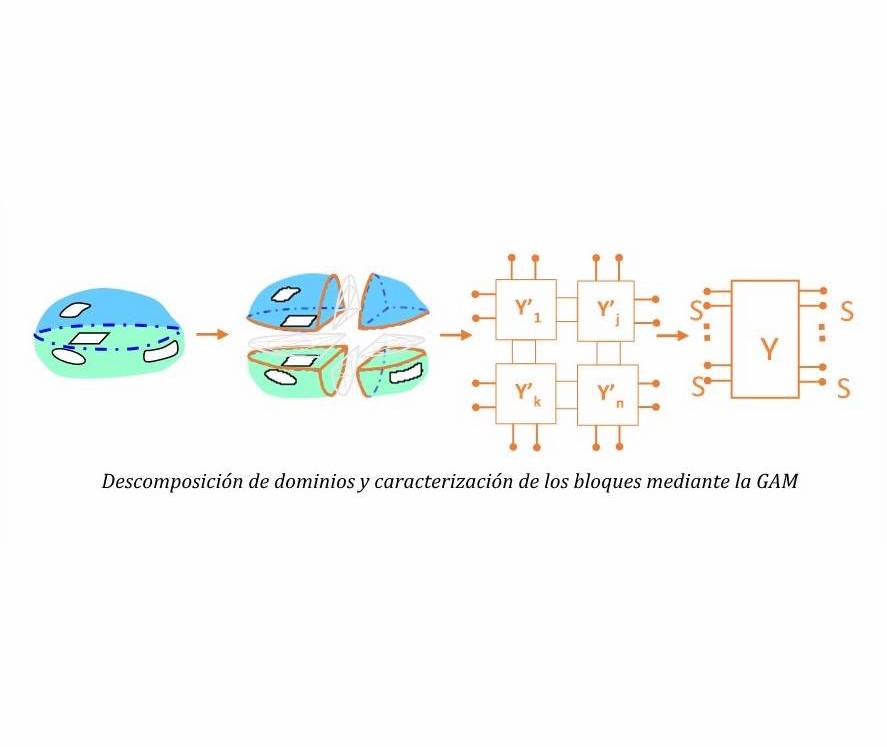
New hybrid methods have been implemented, which add new capabilities for efficient analysis of passive microwave circuits and antennas. Some of them are design-oriented in SIW (Substrate Integrate Waveguide) technology, since it is an emerging low cost technology.

ADDMATE
“New additive manufacturing technologies for passive devices in microwave and millimeter bands (TEC2016-76070-C32R)”
2017-2019
New additive manufacturing techniques are changing the development model in many technology sectors. The objective of the Project has been to develop waveguide devices for space applications and power combination using Selective Laser Sintering using aluminum and copper powder mixtures. Different devices such as modal converters, polarizers and transitions have been manufactured.

SPADERADAR
Space Debris Radar
Comunidad de Madrid, S2013/ICE-3000 (2014-2018)
Several technologies were developed for a space debris detection radar. When located on space platforms such as the International Space Station or communications satellites, the radar would be used to prevent collision with dangerous objects.
ANT4CLIM – High-resolution on-board antenna systems for radiometric monitoring of climate change impact on coastal and fluvial areas – feeder structure (TED2021-130650B-C21
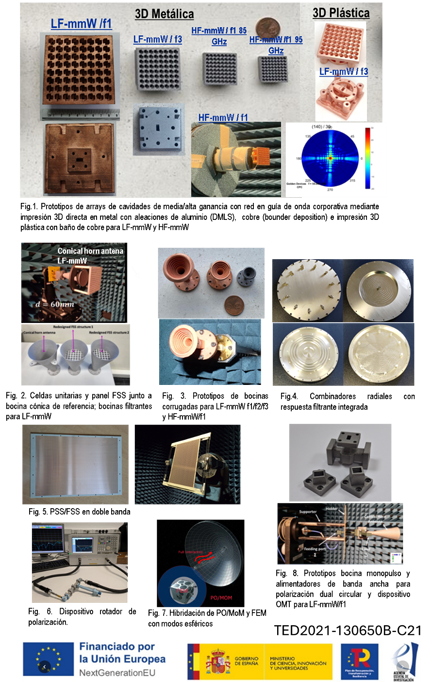
This project has contributed to the development of new antenna technologies, including reflectors and their associated feeds, for satellite-borne antenna systems dedicated to observing coastal and riverine areas, which are highly vulnerable to climate change. Advanced prototypes of feeds and reflectarrays have been designed and manufactured for radiometers capable of operating in millimeter-wave frequency bands, essential for obtaining accurate data on water vapor content in the atmosphere.
ENHANCE-5G: Enabling Antenna Technologies for Smart Connectivity in mm-Wave 5G and Beyond. PID2020-114172RB-C22
The main objective of this project is the development of new antenna technologies that will allow to face the challenges of 5G, as well as B5G (beyond 5G) networks in the millimeter band. This objective is addressed by considering heterogeneous networks in different scenarios, including terrestrial networks and satellite communications. The project includes the design, manufacture, and validation of passive and reconfigurable antennas using different technologies, mainly spatially fed arrays, such as reflectarrays, transmitarrays, metasurfaces, and metal-only solutions. The working bands were mainly focused on the Ka band, which includes 28 and 39 GHz bands assigned to the deployment of 5G networks, although developments have also been made in higher bands for 5G and beyond. The work includes the development of new electromagnetic modeling, design, and optimization tools for controlling and beamforming antennas in mm and sub-mm bands, such as time-modulated arrays, digital beamforming, application of machine learning techniques, etc.


On the other hand, different technologies were developed to implement real-time beam reconfiguration, a requirement for the antennas in current and future networks. The main technological solution for the development of reconfigurable antennas consists of Liquid Crystal (LC) phase-shifting cells for periodic and quasi-periodic planar structures. In addition, solutions focused on the application of additive manufacturing mainly in metal, lenses, and arrays have been investigated. From a final application perspective, one of the main objectives of the project has been to demonstrate new intelligent reflective surfaces (RIS/IRS) to solve the problem of “dead zone” in 5G millimeter coverage, mainly inside buildings. Thus, two RIS solutions are proposed: passive that provide coverage in the near-field area of the RIS, including beamforming, multi-band requirements, or suppression of unwanted bands. and electronically reconfigurable, where an LC-based surface dynamically redirects beam coming from the base station. As part of new communications networks, multibeam antennas have been also developed on LEO and HAPS satellites to provide coverage to users in aircrafts, ships or remote areas. Likewise, new multi-panel reflectarray configurations have been demonstrated, which improve the flexibility for deployment the antenna. Finally, the project had a high degree of experimental development, so multiple prototypes have been manufactured and measured, allowing the experimental validation of the designs.
REALSAT: “Reflectarray-based Antennas for SmallGEO and LEO Communications Satellites” PDC2021-120959-C21-2”
An antenna configuration has been demonstrated in Ka-band that generates multiple beams to provide broadband internet access from geostationary satellites. Current satellites use 4 reflectors to generate a cellular coverage with 2 frequencies and 2 polarizations.
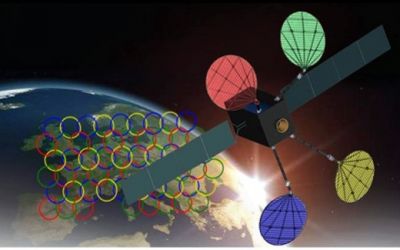
The antenna consists of a parabolic polarizer reflectarray (RA) and a planar sub-RA fed by an array of feed-horns to generate a cellular coverage. The sub-RA separates the beams of each linear polarization, which are then transformed into circularly polarized high-gain beams (LHCP and RHCP). This configuration allows to reduce the number of antennas on the satellite (from 4 reflectors to 2 reflectarrays).
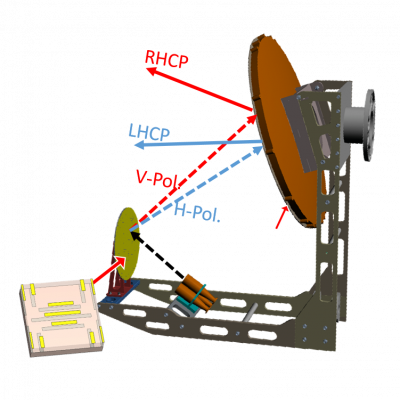
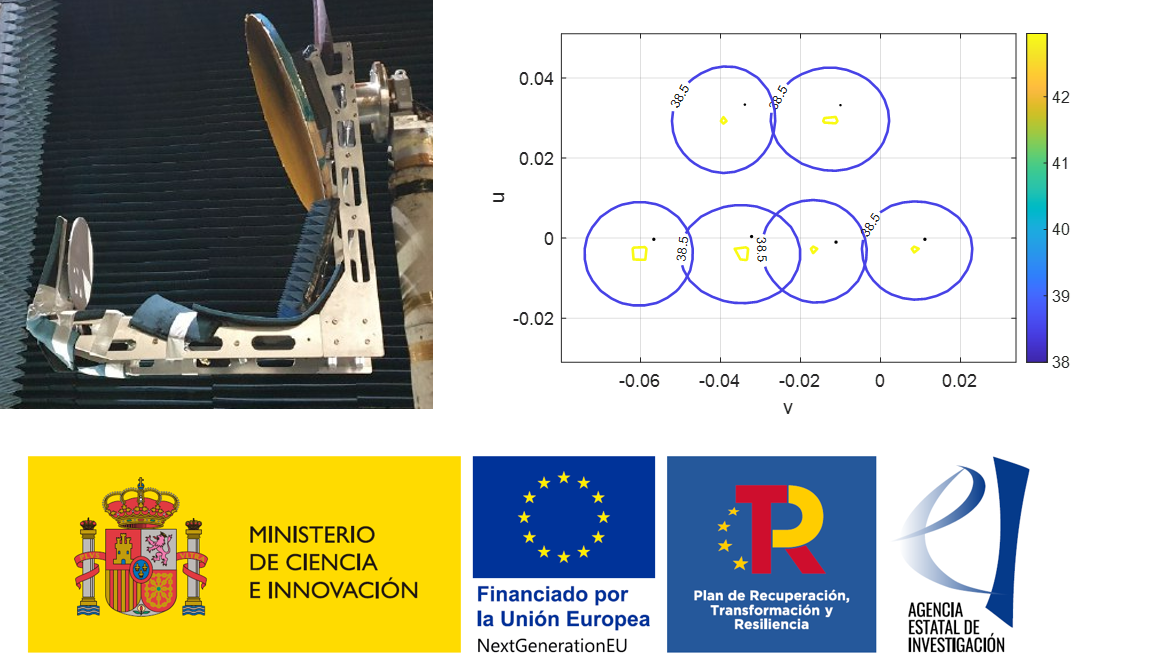
A demonstrator, scaled ½ of a real antenna, consisting of a 90 cm parabolic RA and a 38 cm flat sub-RA fed by 3 horns, has been designed, built and tested. The measurements demonstrate the generation of 6 beams in transmit (19.2- 20.2 GHz) and receive (29-30GHz) frequency bands. This technology allows a reduction in the mass and volume of the satellite payload, being an interesting alternative for geostationary satellites with reduced dimensions and cost.
“New hybrid methods for optimizing high-frequency circuits and antenna arrays”, (TEC2017-83352-C2-1-P)
New hybrid methods have been implemented, which add new capabilities for efficient analysis of passive microwave circuits and antennas. Some of them are design-oriented in SIW (Substrate Integrate Waveguide) technology, since it is an emerging low cost technology.
ADDMATE: “New additive manufacturing technologies for passive devices in microwave and millimeter bands”, (TEC2016-76070-C3-2-R)
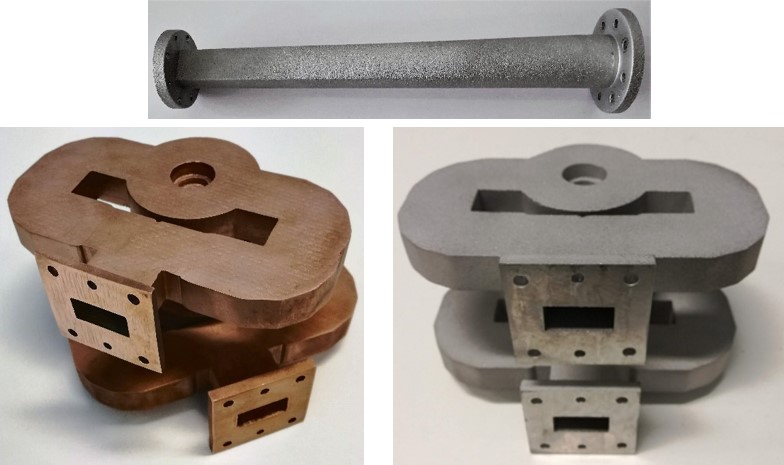
New additive manufacturing techniques are changing the development model in many technology sectors. The objective of the Project has been to develop waveguide devices for space applications and power combination using Selective Laser Sintering using aluminum and copper powder mixtures. Different devices such as modal converters, polarizers and transitions have been manufactured.
SPADERADAR: Space Debris Radar
Project Website: http://spaderadar-cm.com/es/el-proyecto/
New technologies have been developed in this project for a space debris detection radar. It should be noted that there are more than 100,000 objects with diameters less than 10 cm orbiting the earth at speeds of 10 km/s, posing a danger to commercial satellites. It has been necessary to use very high frequencies (94 GHz) to achieve the resolution that allows to detect small objects. Different antennas with electronic scanning capability and accurate arrival angle measurement capability have been designed and built. Various subsystems have been designed, built and measured, and a complete radar prototype has finally been built and validated as proof of concept.